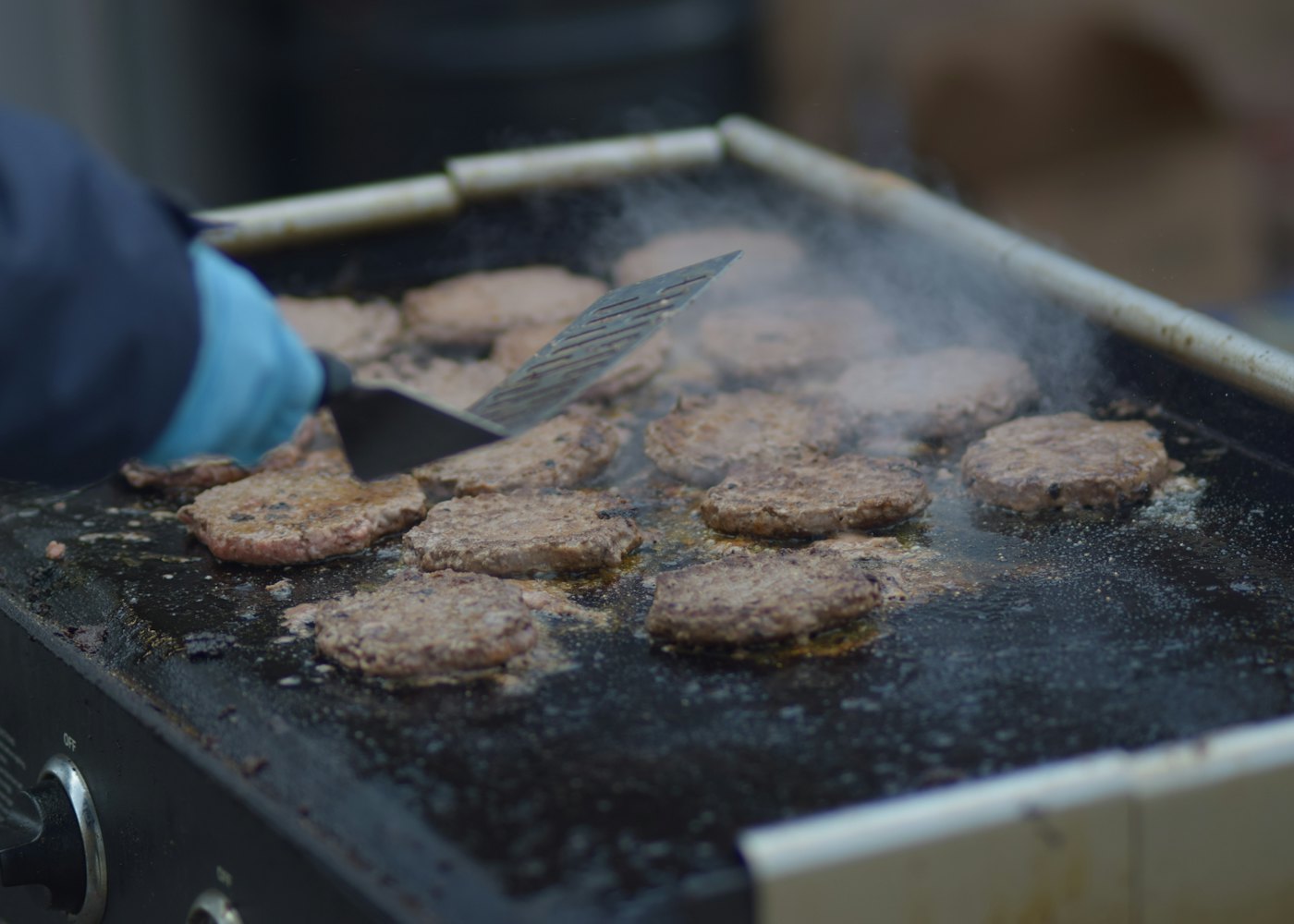
Burgers shrink because heat makes the proteins in beef tighten and squeeze out water, while fat melts and drips away. They puff up in the middle because the edges tighten first and push the center up into a dome. You can't stop shrinking completely, but you can control it: make patties wider than the bun, press a shallow dimple in the center, use a sensible fat ratio and don't overcook.
Why do burgers shrink when you cook them?
A raw patty is mostly water, protein and fat. Cooking changes all three:
- Proteins contract. As meat heats up, muscle proteins and connective tissue (collagen) tighten. Think of a sponge being wrung out: as the protein network tightens, it squeezes moisture out.
- Water evaporates. Some of that moisture sizzles off in the pan or drips onto the coals. The longer the burger cooks, the more it loses.
- Fat renders. Fat melts and runs out of the patty. That rendered fat is a big part of why a burger tastes rich, but it also takes up space that disappears once it leaves.
Put those together and some shrinkage is normal and unavoidable. A burger that loses nothing would be a burger that isn't cooked.
Why do burgers puff up in the middle?
The dome is a separate problem from the shrinking, though they're related. According to America's Test Kitchen, collagen shrinks noticeably once it passes about 140°F. On a grill or under a broiler, heat hits the sides of the patty as well as the bottom, so the outer edge tightens first. That tight edge cinches the patty like a belt, and the softer center has nowhere to go but up.
The result is the classic "meatball burger": thick in the middle, thin at the edges, and hard to keep toppings on. It also cooks unevenly, because the thick center lags behind the edges.
Interestingly, ATK notes that patties cooked in a skillet puff much less, because only the surface touching the pan gets hot enough to tighten the collagen quickly. The edges stay cooler, so there's less of that belt effect.
What makes burgers shrink more
- Higher fat content: more fat means more to render out. Very fatty blends like 70/30 shrink more than 80/20. That doesn't mean leaner is better, though; very lean beef shrinks less but tends to cook up dry. Our guide to the best ground beef for burgers explains why 80/20 is a popular middle ground, and the burger blend calculator can help you plan a custom mix.
- Cooking to a higher temperature: the longer and hotter you cook, the more moisture and fat you lose. A well-done burger is smaller than a medium one.
- Very high heat for thick patties: blasting a thick burger over high heat tightens the outside hard while you wait for the center to cook.
- Overworking the meat: kneading and packing ground beef makes it dense and springy, and tightly packed patties tend to contract and dome more.
- Added water: some ground beef holds more moisture, and mix-ins like ice chips or watery vegetables add water that cooks off.
- Pressing with a spatula: squashing a thick patty mid-cook pushes out juice and fat, so you lose size and flavor at the same time.
How to keep burgers from shrinking
You're really aiming for less shrinkage and an even shape, not zero shrinkage.
- Make patties wider than the bun. Form them about 1/2 to 1 inch wider than your bun so they cook down to the right size. This is the simplest fix of all.
- Choose 80/20 beef. It's a good balance of flavor, juiciness and reasonable shrinkage.
- Handle the meat gently. Divide it, then shape each portion with a light touch, just enough to hold together. See how to form burger patties for a step-by-step method.
- Keep the meat cold. Cold fat stays in the patty longer instead of smearing during shaping and melting out early. Chill formed patties for 15-30 minutes if your kitchen is warm.
- Cook over medium-high, not maximum heat, for thick burgers, and flip when the first side releases easily.
- Don't press thick burgers. Leave them alone and let the crust form.
- Use a thermometer. Pull burgers as soon as they hit your target. The USDA recommends 160°F for ground beef; lower temperatures are a personal risk choice. Our burger temperature and doneness guide has the full chart.
The thumbprint trick: how to stop burgers from puffing up
To keep patties flat, press a shallow dimple into the center of each one before cooking. Use your thumb or the back of a spoon and press down about 1/4 inch, leaving a slight well that's roughly an inch or so across on a standard patty. Use a smaller dimple for sliders.
As the edges tighten and push the middle upward, the center rises to fill the dip instead of doming above it. By the time the burger is done, the dimple has mostly disappeared and you're left with a flat patty that holds toppings and cooks evenly.
A few tips:
- The dimple matters most for grilled and broiled burgers, where heat hits the sides. On the grill, see our guide to grilling burgers for timing and heat zones.
- It helps less, but doesn't hurt, in a skillet. For pan burgers, our guide to cooking burgers on the stove has more technique.
- If you're freezing patties, dimple them before they go in the freezer.
- Smash burgers don't need a dimple at all. They're pressed thin right at the start, so there's no thick center to dome. Learn more in smash burger vs. regular burger.
Does shrinkage mean a burger is worse?
Not necessarily. Some shrinkage means fat has rendered and the outside has browned, which is where a lot of flavor comes from. The goal is a patty that ends up the right size for the bun and still tastes juicy. If your burgers consistently end up smaller than the bun, make them wider. If they're consistently dry, look at your fat ratio and your final temperature before anything else.
Frequently asked questions
How much do burgers shrink?
It varies with fat content, how long you cook them and how hot the heat is. Fattier beef and higher doneness both mean more shrinkage, which is why forming patties a bit wider than the bun is the usual advice.
Why do my burgers turn into meatballs?
The edges tighten first and push the center upward. Press a 1/4-inch dimple into the middle of each raw patty, and avoid packing the meat too tightly when you shape it.
Does lean beef shrink less?
Generally yes, since there's less fat to render. But lean beef is easier to dry out, so many cooks accept a little more shrinkage from 80/20 in exchange for a juicier burger.
Should you press burgers while they cook?
Not thick ones. Pressing squeezes out juice and fat. The exception is a smash burger, which is pressed once, hard, in the first moments of cooking, before juices start running.
Do frozen burgers shrink less?
Freezing doesn't change the meat's fat or water much, but some cooks find frozen patties hold their shape well because the outside sets before the center warms. Cook them to the same 160°F target.
Hungry for more?
Find great burgers near you or cook one tonight.